Community = Common Unity

“Community” is on the lips of every local politician and every civic organization. Whether schools, churches, or mosques we all want to see stronger communities; but what do we mean by community. When we say community where are the boundaries and borders? Is it a one block radius around my house, or the whole area of the housing development? Is it the designated name of an area used by voting districts or property taxes, or is it the area used for postal services by zip code? In smaller towns is it the whole town or just the city limits? Perhaps it is time define or redefine community for everyone.

If you study the etymology of the word community you will find its origins in Latin, and Old French. In Latin it is the word “communis” meaning the same and “communitas.” meaning common, public, shared by all or many. Our English word community is an adaptation of these words from the Old French word “communaute” which refers to public spirit or commonality. Outside of the fact that I love studying the historic context of words it always interests me that most words we consider to be “American” are actually borrowed words from other languages. Needless to say, over time words seem to take on new meanings and lose their intended and original definition. So, allow me to simplify the meaning of community for this blog post as derived from this background: Community equals Common Unity,

Several weeks ago, a huge oak tree fell in my front yard. We were lucky that it fell at an angle, so it didn’t hit our home or the homes of our neighbors. It did fall across the street and left limbs and debris in our neighbors’ yards as well as blocked the entire street. A young man came over from the end house and offered to help my husband clean up the debris and cut and remove the tree. It turned out that he owned a tree cutting and removal business. Another neighbor from the cul-de-sac came with power saw in hand to help with the cleanup too. The young business owner finished the job of removing the fallen tree and proceeded to cut bad limbs on other trees in our yard. He also pruned my crepe myrtles and inspected other trees on our property. When my neighbor to my left came home there was no evidence that our tree had left limbs and leaves all over her yard. It turned out that this young businessman who was relatively new to the neighborhood has helped people all over the neighborhood. When asked what was really in it for him, he said, “This is my community it’s our job to help one another.” Imagine that. This young man saw our entire development as his community.

That fact is disaster has a tendency to draw a community together. Floods, hurricanes, fires, all these things bring families and neighbors together because they are experiencing “communitas.” Trauma, grief, upheaval, and lost is the commonality that brings everyone together. Differences are put aside. Unity of purpose is understood in terms of survival and rebuilding. This is commendable, but also temporary. I am always amazed how people come together from all over the country to help individuals in these disastrous situations. Yet, why should it take catastrophe to remind us that we are one community.

Before calamity happens, we have a common unity. Every parent wants a good education and a safe environment for their children. Every bread winner wants to make enough money to take care of their families. Renters want to become owners. Owners want to maintain their property values. Everyone wants to have nourishment and clean water to drink. All people need clothes appropriate for the weather and affordable housing. Healthcare and retirement income are all common needs amidst the aging. Everyone sheds tears at the loss of a loved one. Everyone is pursuing happiness – the so-called American dream. These are not political talking points; these are community needs. These are the things we have in common with our neighbors and others who live in our region. These are reasons for us to relate to one another and to help one another. If you really think about it, we have more in common than we have as differences. Pain, fear, hope, dreams, struggle, thriving are all part of our common experiences.

Rather than allowing politics, racism, sexism, classism, and other social economic circumstances to polarize us why can’t our commonalities unify us? We breathe the same air. We walk or drive the same streets. We have the same desires for our families. This is not rhetoric; look around our world. Here’s the reality and if we are not careful, we will create more disasters to draw us into unnatural communities. Let’s remember our common unity before things around us get worst. We should build our community to make it stronger by stepping in to help in any way that we can. Like the young businessman I mentioned above, we can use our expertise to make our communities better. Like the neighbors that came to help us, we can use our collective efforts to fix and clean up our shared space.

It’s time to unify. It’s time to be a real community. It’s time to capitalize on our common unity. PEACE!


Photo by Kaique Rocha on Pexels.com

Working with The Unexpected

This past week I accepted a job as a kindergarten substitute teacher. To my surprise, I had a second-grade class to teach when I arrived. The inner child in me wanted to pitch a fit and leave, but the teacher in me decided to work with the unexpected. That got me wondering how others respond to the unexpected in life. How do you respond to the unexpected? (No, really. Please share.)

Unexpected things in life can be both good and bad. You could get a promotion, that’s good. You could get a pink slip, that’s not so good. The doctor could give you a clean bill of health, or the doctor could pronounce the dreaded disease of cancer. A tree could fall on your house in a storm, or someone could rear end your brand-new car. Your favorite person could pay you a surprise visit. You could find out you’re having twins. The best restaurant ever could go out of business. The one you love could propose. Life is filled with unexpected challenges and pleasures. Sometimes we have to learn to work with them whether we want to or not. We would all rather walk away from disappointment and choose only the “good” things, but that’s not the way of life.

Many years ago, I thought I had achieved my dream occupation as an educator. A friend, my spiritual leader and I joined forces and founded a Chrisitan school. The school grew out of an academic summer camp I had been running for years. We named the school after my great grandparents Will and Mariah Jackson. We started with pre-kindergarten through second grade. Each year we added another grade until we reached grade five. Everything was going well. My godson handled the bookkeeping. My friend’s wife handled the day-to-day office work. The staff was well qualified, and the students were learning and enjoying their teachers and activities. Everything seemed to fall in place. We bought new furnishings for our classrooms from a local school district. A donor gave us enough computers to start a computer lab. This had been my dream for years because my children had been products of this type of school in California. My partner and I were happy with the impact of our little school. Then the unthinkable happened.

One cold winter night, my friend’s wife called me, “He’s gone,” she said. My friend, my spiritual advisor, my business partner had died. Out of nowhere he had a massive heart attack. There were no signs prior to this that warned us. There was no opportunity to bargain or change paths. It was devastating to everyone, especially his wife and family. Grief and sadness filtered down to everyone that knew him – the students, the staff, the members of his congregation, organizational leaders, and even the community at large. Even as I look back now, it hurts my heart. The loss was tremendous, and the empty space could never be filled by another. Eventually, I crumbled, and the school closed.

Why am I talking about this now? Because we live with the unexpected every day. Big things, like the one I just conveyed, and small things like having a cavity. The unexpected is to be expected. Mass shootings at schools, shopping centers, and places of worship; random stray bullets barrowing into homes; senior citizens being scammed out of their life savings; women and children being abducted off the streets, and major companies closing their doors for good are just a few of the unexpected things that can and do occur in our world today. On the flip side there are good, unexpected things as well – new community alliances that pass out food and clothing to the needy; the revitalization of Neighborhood Watch programs; young entrepreneurs creating new jobs; free lunch programs for school-aged children; and unexpected benefactors paying off student debt at the local HBCU. So many unexpected things can happen at any given moment.

Sometimes I find myself trying to explain the world to my 91-year-old mother and my 21-year-old granddaughter. Mom wants to know why things can’t go back to the way they used to be, and my granddaughter wants to know what to expect in the future when things are always changing. Mom experienced loss in so many ways during the pandemic – loss of friends and community, loss of the ability to drive and socialize, loss of freedom – she had to learn to live in a new kind of normal for her own safety. My granddaughter graduated from high school during the pandemic. There was no prom, no graduation ceremony, and no community celebration. Her first semesters at college were spent on-line in the dorm room rather than in person. None of the expected challenges or standards seem to exist in her new world. In other words, mom is trying to adjust to the impersonal world of technology and AI, while my granddaughter is trying to adjust to being thrusted into adulthood with all its responsibilities and none of its former assurances. Each of them – all of us – must learn to work with the unexpected.

We can’t allow the unexpected to leave us halted in fear. We can’t allow the unexpected to styme our growth or our dreams. We shouldn’t just stop in our tracks and wait for the next blessing or disaster to get us moving again. Nor can we allow corruption in high places to corrupt our moral compass and values. We must learn to work with the unexpected, because the unexpected is not going away. We have the tools to do it. We can network with like-minded people. We can elevate our problem-solving skills through study, lectures, think tanks, and podcasts. We can adjust our schedules, become change agents, form or change our inner circles while taking advantage of technology and interpersonal relations. We can work with the unexpected. We simply need to make and stick with a plan to move forward.

I have a friend who says you always need a plan C. C stands for courage, and we all need that when plan A and B fail. Plan C will help us ask for help. Plan C will help us admit it when we are wrong. Plan C will give us the ability to start over. Plan C will allow us to celebrate the victories of others even when our victories stop coming. Plan C will help us navigate and work with the unexpected with a “we can” spirit. In the Words of the Pointer Sisters, and for Women’s History Month, I leave you with the lyrics of their song: “...I know we can make it. I know dare well we can work it out. Oh yes, we can, I know we can, can. Yes, we can, can…” With a little courage, we can work with the unexpected.

Developing Character

As an author of short stories, I spend a lot of time trying to develop my characters. Depending on the role each character holds – antagonist, protagonist, comic relief – their character must reflect their thoughts and actions. What is their back story? What is their worldview? What is the driving force behind their emotions and their relationships? Character isn’t just the outward appearance of a person; it is also the inside makeup of that person. If this is true in the world of make believe, how much more is it true for each of us here in the real world?

We are charged with being a person of good character. Whether we have had a great life, or a life filled with hardship, we are tasked with what kind of character we have. Whatever role we play in society, our character is reflected in our interactions and relationships. We have a choice in who we become. We have a choice in what kind of person we want to be. Unlike the characters in my book, we have a say in whether we are what we appear to be. We can construct and develop our own character. 

I do know that some would argue against that last statement. There are many who believe our back story and our environment make us who we are. How many times have I heard that this child or that child is a product of their environment as if one’s environment is made up of a stagnant singular place. What part of one’s environment has the most influence? Home? School? Socio-economic Community? How do we explain the differences in character of people who come from the same “environment.” Why does one person rise to the top while another person scrapes the bottom of the proverbial barrel for a lifetime? One individual chooses to rise above their circumstances. Another person chooses to invest time developing character and high standards of thinking and acting. 

So, what is character? According to the Oxford Dictionary character is: ”the mental and moral qualities distinctive to an individual; strength and originality in a person’s nature; a person’s good reputation.” These qualities include personality, temperament, outlook, and disposition. The question becomes do we control these traits or does some outside force control us like the author of a book. Do we have a say? I think we do. We have the ability to look into the mirror and decide what kind of person we want to be, and we have the ability to change. 

This week I decided it was time to clean my office. In the process I came across my junior high and high school yearbooks. It was interesting to read the comments made by my teachers and peers. Many of these autographed inscriptions spoke to how they saw my future based on my character as a student and friend. One of the characteristics that many of them seemed to pick up on was my ability to shut people out. Some even connected this attribute with my temper and temperament. So, they made statements like: ”If you stop being so evil you will go far.” ”If you let people see the real you, you have a bright future ahead.” Several people said they wished they had gotten to know me better even though we had been classmates from elementary school through high school. I can look at many of these comments and smile, but I also have to take in consideration how much I have changed or not since then. Do I still cut people off? Do I still appear mean and temperamental all these years later? It’s interesting that my closest friends from that era (who are still in my life today) still see me the same way. While friends and colleagues who never knew me before, see me as outgoing and congenial. Very few classmates saw me that way. This speaks to outward appearances as well as personal responses to people and circumstances. 

We can develop our character to present a different set of traits in various situations. Different people may know and see us in different ways than others. Yet, our character should not have a Jekyll and Hyde persona. If we are good moral people, this should be obvious in all circumstances. If we are kindhearted and fair, it should manifest in our speech and actions. If we are reserved and tactful, no one should be able to describe us as radical and outrageous. If we are even tempered and ethical, riotous rage should never explode uncontrollably from our tongue or actions. We can develop our character by our life choices every day. We can change what we don’t like, and we can enhance what we love. Our choices may determine our future successes and defeats as stated by my old autographs, but it may also lead to better and safe communities.  

Some of the ills in our world today go back to character development. Our communities need good characters – persons who consider good citizenship, neighborliness, and moral consistency to be the qualities of maturity and health. As an author, I don’t want to create a book filled with antagonists. This would be a hostile adversarial environment with no relief in sight. How would the story end? More than likely, it would end in self-destruction and hopelessness. Every story needs a protagonist to support and champion a good outcome. Our real world needs more protagonist: heroes, heroines, advocates, champions, opposers of evil and destruction. Character development can help in a mighty way to transform our antagonistic world. 

May we all continue to work on our character and help our youth to develop good character that will transform their lives and ours. Happy MLK Jr. Day!

I have a dream that my four little children will one day live in a nation where they will not be judged by the color of their skin, but by the content of their character.”  Martin Luther King Jr.

Holiday Sensitivity

This is the time of year when everyone is bombarded by holiday sales and decorations weeks before the holidays begin. Everywhere you look there is red, green, gold, blue, and silver garland. Toys and small appliances sit on the end caps of every store shelf. Even the piped-in music invades the atmosphere with subliminal messages of whimsical dreams, glee, and laughter. Before we get off to a bad start, I want you to know I am not intrinsically opposed to any of this (well maybe the sales campaigns and ads); I am just calling for some sensitivity during these seasons of holiday cheer. 

During the week of the national Thanksgiving holiday, we lost one of the matriarchs of our family. Her death was very disheartening not only because it was unexpected, but because of what she represented in our family legacy. She was the last of my maternal great grandfather children. As we grieved and prepared for her memorial and the celebration of her life, I was struck by the incongruent sentiments of condolences and “Happy Thanksgiving.” People asked, how was our Thanksgiving, did we cook a lot, eat a lot, or host a large gathering. At times I felt trapped between my own grief and trying not to dampen the spirits of people who were enjoying the holiday season. They meant well and were simply pursuing polite conversation, but I was not in the mood for it. I wondered if they even noticed my countenance or my monosyllabic responses. Few were sensitive to my hesitations; even co-workers didn’t seem to notice the strain. 

There I was trying to be sensitive to the needs of others by keeping my bereavement to myself. There I was trying to make sure I didn’t spoil their holiday cheer. I reasoned with myself; they didn’t know my great aunt. They wouldn’t understand what she meant to our family legacy. They certainly weren’t in the mood for a long explanation concerning the impact of her death. So, the sensitive thing for me to do was grin and bear it. Right? The aftermath of this was a reminder that everyone is not experiencing a season of cheer just because it is listed on the calendar. 

Upon reflection, it occurred to me that sensitivity is needed more than ever. First and foremost, we don’t all celebrate the same holidays. There are at least twenty-nine (29) holidays between November 1st and January 15th for seven major religions. These include national, cultural, local, and international days of celebration. Secondly, many people are limited in how they participate in holiday events. Socio-economic circumstances, health issues, as well as displacement from home and family can affect one’s participation.  When you are struggling to survive financially, holidays are not a top priority. When you are struggling with chronic disease or dis-ease, cheer may evade you. Yet, we often overlook these things when we are focused on ourselves and our own expression of the seasons in our lives. 

Holiday sensitivity doesn’t mean we have to stop celebrating our own special days, weeks, or months, but it does mean we should allow space for those who do not share our enthusiasm. We can pay attention to the needs of others. We can watch how they respond when we greet them. We can ask questions about their lives and their celebrations. We can practice attentiveness. Does the person we are talking to seem sad or confused? Does the person seem preoccupied or different in any way from their “normal” selves? Perhaps they are less talkative. Perhaps they have something to share with you. Perhaps they are trying to be sensitive toward you while you are not being sensitive toward them. 

I was brought up in the generation where we were taught to look a person in the eye when you speak with them or when they speak to you. You can learn a lot by making eye contact with people and observing their body language. (Things you’ll never get from a test message, but that’s a subject for another day.) Holiday sensitivity reminds us to be careful not to offend others and at the same time not to be easily offended. ”Happy Holidays,” are not words of challenge. It simply acknowledges the possibility that we may or may not celebrate the same calendar days. If a person greets you with a specific holiday expression, accept the fact that this is their time of celebration. Their oversight usually isn’t personal. Most of all understand that many people are struggling with day-to-day stresses and pressure. Depression, inflation, grief, heartache, or other issues of anxiety may be a hinderance to their attention to celebratory situations around them. They may require a little empathy on our part. They may require a hand-up or a handout on our part. They may require genuine concern and friendship from us. They may sincerely require and desire to be included in our community and in our celebrations. Let’s be more sensitive to the needs of other whether it’s a regular day, a holy day, or a holiday. It will make for a better community. 

Be kind. Be neighborly. Be sensitive to those around you. Peace and Good Cheer to all. 

Real Effort

One thing you notice as a teacher is the students who are making a real effort. That doesn’t mean all their answers are perfect or that they are the best students in the room. It means they are doing their best to meet the goal; they are determined to give it their best shot. I am always proud of these students. I also try to encourage them to continue their hard work because it will pay off in the end. There may be delayed gratification, but real effort leads to real achievement.

It takes real effort to improve our status. Unfortunately, too many of us give lip service to real effort while doing as little as possible. Our contribution to the finished product is minuscule. We do just enough work to get by or to keep others from saying we didn’t do anything. We don’t seem to realize we are shortchanging ourselves. Every accomplishment leads to new heights of understanding and confidence. Hard work and success enriches our lives and informs our character.

Collaborative learning came on the scene several years ago in all the high schools and colleges (also used in elementary education today). Courses were designed for students to work in small groups and to finish projects as a team. One student came to me totally frustrated. Her complaint was about the slackers in her group. Apparently, they had had an initial meeting where it was decided what each member of the group was responsible to do. They also scheduled several follow-up meetings to check their progress and prepare responses for the discussion board. At the first scheduled meeting only three of the eight students showed up, one being my student. At the second meeting five people showed up, but only the original three had anything done. The professor was checking the discussion board, but no one from this group had submitted any responses. They received a written reminder and reprimand from the professor. Discussion board participation was part of the overall grade. My student said she and her other two classmates were going to try to do the whole project by themselves in order to get a passing grade. I advised her to take all of their finished work and their assignment lists to the professor rather than three people trying to do the work of eight people. The professor listened to the three students and assigned them to another group where some of the work they had done could be used. The new group of ten people did quite well on their oral presentation and received a “B” on their written presentation. The remaining five students from the first group ended up arguing in front of the whole class during their oral presentation. I don’t know what grades they received but I do know they were called to a meeting with their professor. I do know that all this drama could have been avoided if everyone in the group had put forth some real effort.

We need real effort in our society today. We can’t just give lip service to humanity, equality, and civility. We must put forth some real effort in non-violent communication. We must put real effort into active listening, empathy, and cultural awareness. Harmony and respect take effort. Understanding and advancement requires teamwork where everyone is doing their part. Civic duty, volunteerism, and neighborly conduct is just the beginning.

When I am writing a story or a poem, I am always aware of the universal themes that underlie the specifics of the project. Love, family, community, dreams, hopes, legacy, inheritance, work and struggle are experiences and desires that transcend time and class. We all want our children to thrive. We all want our communities to be safe. We want our families to prosper. We want our leaders to lead with integrity. We want to reap the benefits of our labor. All these things require real community effort. We all have the opportunity to contribute to our societal whole. We have an assignment to fulfill as members of the human team. When I was younger, we called this good citizenship. My school district calls it community shareholders. The consequence of no effort is severe and affects every area of our society.

When I was in junior high (it’s called middle school today), our choir director taught us a beautiful song that I still remember to this day. The first lines of the song say: “Let there be peace on earth and let it begin with me. Let there be peace on earth the peace that was meant to be . . .” (Listen to the whole song here: Let There be Peace on Earth) Real effort begins with me, but it ends with all of us doing our part to bring harmony to our Beloved Community. “It takes a village” can no longer be a slogan, it must be a reality. It needs to be a work in progress each and every day if we are going to create a better society.

Promote kindness. Live peacefully. Cultivate charity. Learn to “love your neighbor as yourself.” Give it some real effort. Peace!

Be a lighthouse. Light the way for the next generation.

Confronting Grief

Every day for the last few weeks I’ve been thinking about writing something for the blog, but the only thing that came to mind was the word grief. Well, of course, that’s not what I wanted to write about. Grief is depressing and I want to write something to lift people up, not bring them down. So I wrestled with myself until I gave up. Grief is on my mind, so I might as well share. As I chat with others, I found out that grief is not only on my mind, but it’s also on the mind of many others.

First, a disclaimer. I am not a counselor. I am not a life life coach. I am a writer always trying to capture a thought in print. I write from within my own heart and I write from all of my senses and experiences. So please if you need help with grief, seek a professional counselor (I do), but if you need some help putting words to your thoughts and feelings, then this may help.

My understanding of grief is that it is an emotional and mental reaction to loss, whether that loss is actual or perceived. So right now, we are living in a grieving society. People have lost their loved ones to COVID and other illnesses at a time when hospital visits and stays with family is restricted. People have lost jobs and businesses. People have lost their rituals and routines. Some have even lost their identity as it was tied to their career or their status and position in life. Children are missing their friendships. Graduates feel cheated out of their celebrations. Grief is all around us. We have been blind-sided by multiple losses, and recovery is uncertain in this far-from-normal environment.

So how do we deal with all this grief? First, we must be honest about it. Pretending we are not sadden by the events of our lives since March is only going to make it worst. When we ignore our thoughts and feeling, they have a way of showing up in our sleep patterns, our appetites, and our relationships. My husband’s biggest pet peeve is when he says, “What’s wrong?” and I say, “Nothing!” when there is obviously something wrong. We can lie with our lips, but not with our hearts. Our subconscious brain is working to solve the problem even when we are in conscious denial. Grief is a natural response. We can admit it. We can share it. We can help each other get through it when we expose its existence.

Secondly, we can release our emotions. It’s okay to cry, to pound the desk, to scream, punch a punching bag, and most importantly to discuss your feelings. Sometimes, I say, “I don’t want you to say anything just listen. I need to talk about how I feel.” We all need someone who will actively listen to us, lend us a shoulder, or simply be present with us as we go through life’s journey. When we don’t take the time to purposely express what we are feeling, it will show up at an inopportune time. We end up showing anger to someone who doesn’t deserve it, or crying uncontrollable when the occasion calls for laughter. Find a time and a place to release your emotions; to share your feelings. Others will understand. Mostly likely, they will identify during this time of pandemic and protest.

Lastly, a suggestion that sounds so cliche, I almost don’t want to write it. “Count your blessings.” As I have reflected on grief these last couple of weeks, I found myself going down the complaining-murmuring road. After a while everything was colored with the crayon of doom and gloom. I found myself sitting in front of the TV news much too much. I found myself isolating from the family I live with. I found myself not wanting to get out of bed. Everything was wrong, nothing was right. That’s a very dangerous place to be. That’s a mental health trap. Thank goodness, someone reminded me to count my blessings. Literally, I counted my blessings. (We talked about a thankful journal before. A thankful journal is very therapeutic.)

I wrote down all the things I was thankful for, all the physical, financial, spiritual, emotional, and mental blessings I could think of in that moment. Everything was not going to hell in a hand basket. Everything was not awful. There was lots of good, wholesome, healthy, and joyous stuff – people and things – in my life. In the midst of my losses, there were some great gains. I won’t name them all to you, but suffice it to say, I found a few reasons to smile.

I hope this reflection on grief is helpful to someone. You are not alone. Grief is taking its toll on our world right now. In the midst of it, remember it hasn’t taken everything. If you are reading this, you have the ability to see, to understand, to critique (lol), to feel. If there is anyone you can call, you have a friend or family member available to you. If there is a path or a sidewalk nearby, you can experience nature, you have the ability to move around whether by legs or wheelchair. Share your grief in community. Share your joys in community. Count your blessing in community. It’s in community that we will heal!

Continue to confront life and be safe!

Good Grief: A Companion for Every Loss
For more than fifty years Good Grief has helped millions of readers, including NFL players and a former first lady, find comfort and rediscover hope after loss. Amazon.com
Broad enough to encompass many forms of grief, this book reassures kids that they are not alone in their feelings and even suggests simple things they can do to feel better, like drawing, dancing, and talking to friends and family. Amazon.com

Closing the Distance

We were all hoping the Corona-virus would be conquered by now. We were praying for a large downswing in the curve. Instead it is still running rampant, and we are still called upon to socially distance ourselves. Unfortunately, this is taking its toll on our mental and emotional health. (At least those of us who are obeying the mandates of medical experts and the CDC.)

Social distancing is suppose to mean keeping at least 6 feet between you and another person. Perhaps this was a poor choice of words. Perhaps we should have called it physical distancing. After all, we are social creatures. We need companionship. We need our sense of community and family. This innate need and desire has not gone away in the face of a pandemic, nor should it. What we have to do is modify our social behavior rather than nullify it.

I decided to have a family cookout. Our entire immediate family was present. There were no hugs, no handshakes, and no kisses. Each person arrived wearing a mask. Each person proceeded to the bathroom to wash their hands. We headed to the patio where each person sat or stood with enough distance between them to satisfy the health considerations of the elderly among us. We laughed, we talked, we ate, we drank, and we reminisced days gone by. All of our utensils, cups, and plates were disposable. I’d like to think a good time was had by all. This is just one of the ways we closed the distance in our family. It did my heart good to see with my own eyes that my sons and their families were doing well. (All of them have been working outside their homes throughout the pandemic.)

Yesterday, I talked to a friend in southern California. She told me that she and four of her friends went to the neighborhood park, mask in place, and had a great two hour visit under the trees. She said each of them enjoyed this short visit so much because all of them live alone and longed for human contact. This friend is over seventy years old. She does not have internet access so her interactions have been limited to telephone. (We were on the phone 3 hours. It was easy to ear how much she needs social interaction.) She also shared with me that some places there have made drive-in movies in the parking lots of Walmart stores to provide an outlet for social activity. I was happy to hear that my friend was finding ways to close the social distance between her and her friends.

Staying home, cutting ourselves off from all human contact, especially for those who live alone, can weigh heavily on the soul. Depression and anxiety can grow in a way that destroys the joy of living. I’m writing this short blog to remind us that there are ways to come together safely.

We don’t have to be socially distanced in a way that leaves us in solitude each and every day. We can find ways to close the distance, while keeping some physical distance between us. Here are a few suggestions: Walk around your neighbor, speak to neighbors and others who are outside in their yards; better yet walk with a friend. Drive to the lake or to a community you’ve always wondered about, then call a friend and tell them about everything you saw and felt. Offer to Face-time and elderly person’s children and allow them to have a conversation on your phone by putting it in a plastic food bag. Share conference call numbers for prayer meetings and bible studies with the people you know. Set up a drive-in movie in your church or club parking lot. Invite a friend to the park for a foot race. Set up a conference call to exchange recipes or gardening tips with your friends/family. Go to the golf range with a companion; hit a bucket of balls.

You may still need to wear your mask, use your hand sanitizer, and maintain a proper physical distance from other people, but you can still be a social member of your community. Stay connected while you stay safe and close the distance between your family, friends, and neighbors.

PS: Connect your doctor or a mental health professional if you are feeling depressed and anxious beyond what you can handle. This is a necessary distance to close.

Walter is a good storyteller. His stories will make you laugh and cry — and sometimes pray. He knows the pain of failure and the joy of being rescued by caring friends. In these stories you will find inspiration, laughter, hope and encouragement. Walter hopes that you will find a story that moves you to give thanks for the people who held the rope for you when you were a “basket case,” and inspire you to hold the rope for a hurting friend. Amazon.com

Real Neighbors

This is a time when we all need real neighbors. I, for one, had begun to believe that real neighbors didn’t exist. I mean, not like the neighborly neighbors of times gone by. My neighbors and I wave at each other when passing by in our cars, or say the “how you doing?” when we happen to meet at the mailbox at the same time but that’s it. We all work various hours and the rat race sets the pace of our lives for socializing. At least that was true until the recent Corona-virus crisis.

My neighbor diagonal across the street walked over from her driveway to mine. I spoke to her by name and wondered what was up. She told me she was a pediatric nurse by profession, and if I ever needed anything related to my children, day or night, not to hesitate to come and get her. She told me her work hours and our conversation turned to how long she had been living on our street. It turned out that she had been living on the street for many years; she knew all the neighbors from before we moved on the street.

After our conversation at the mailbox, I went inside to share all that I had learned with my mother. Turns out, my mom is a pretty good neighbor herself. She knew many of the people currently on the street by name, as well as their family makeup and health conditions. In fact, she had been a rescuer for our neighbor directly across the street. He had been up on his roof cleaning gutters when his ladder fail leaving him stuck on the roof for hours. Thankfully for him, my mom came home from from errands; he was able to call to her. She went over, put the ladder back in place, and held it until he was able to climb down to the ground. Needless to say, they have been good neighbors ever since.

One of my grandchildren’s other grandma’s lives in our neighborhood. She called me one day completely beside herself; her little dog had disappeared from her yard. She lives alone and her dog is a big company keeper for her. I assured her that Harley would show up. The weather had been so crazy I figured he was chasing a squirrel or rabbit and would show up sooner or later. Harley did not show up that night. Members of her family had searched the neighborhood calling for the dog. Two days later one of her neighbors, that she did not know, brought Harley home. The neighbor had heard about her despair; she too searched for Harley and found him. Needless to say there was much joy as well as a new friendship established.

Why do we need crisis to become good neighbors? (I certainly am convicted.) I mean it’s great that we do it doing these times, but I want to be a good neighbor all the time. If I’m to busy to spend time getting to know people who live right around me, then I’m simply too busy! Nothing (here I mean no things) can be more important than people. My personal investments are off when all my time is spent chasing the rat. It’s time to make a change! To borrow a slogan from an insurance commercial, “Like a good neighbor,” I want to be there! What about you? How’s your neighborly thermometer? Cold or hot?

Good Neighbor: The Life and Work of Fred Rogers
The definitive biography of Fred Rogers, children’s television pioneer and American cultural icon, an instant New York Times bestseller  Amazon.com

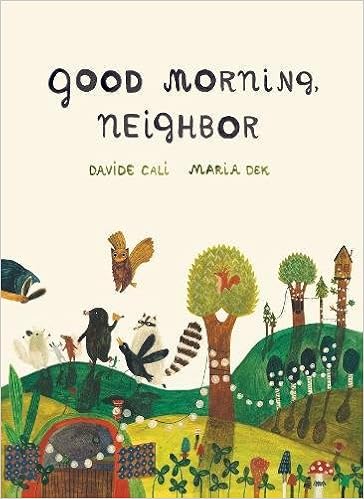
a picture book on sharing, kindness, and working as a team for ages 4-8 available on Amazon.com